
A young law student from Hong Kong took a working journey deep into mainland China’s Shanxi province. Tang Chun-man found extraordinary reminders of the country’s dramatic history – but he also found himself taking an internal journey to gain an appreciation of two legal systems, different in many ways, but both grounded in the universal principles of law.
SO THERE I WAS, on the scorching loess plateau of Shanxi. This was July of this year, and I was one of thirty interns from Hong Kong embarking on a marvellous journey.

I had rarely had interactions with mainland China in the past, so I had to step out of my comfort zone to explore this land. It turned out to be fruitful trip that brought immense rewards.
Throughout the month, we navigated Shanxi from north to south. This is a province in China, not far from Beijing, and sharing a border with inner Mongolia to the north.
The Chinese saying “to see cultural relics above ground, look to Shanxi” rings true, as we found the province was endowed with countless historical treasures. Some examples:
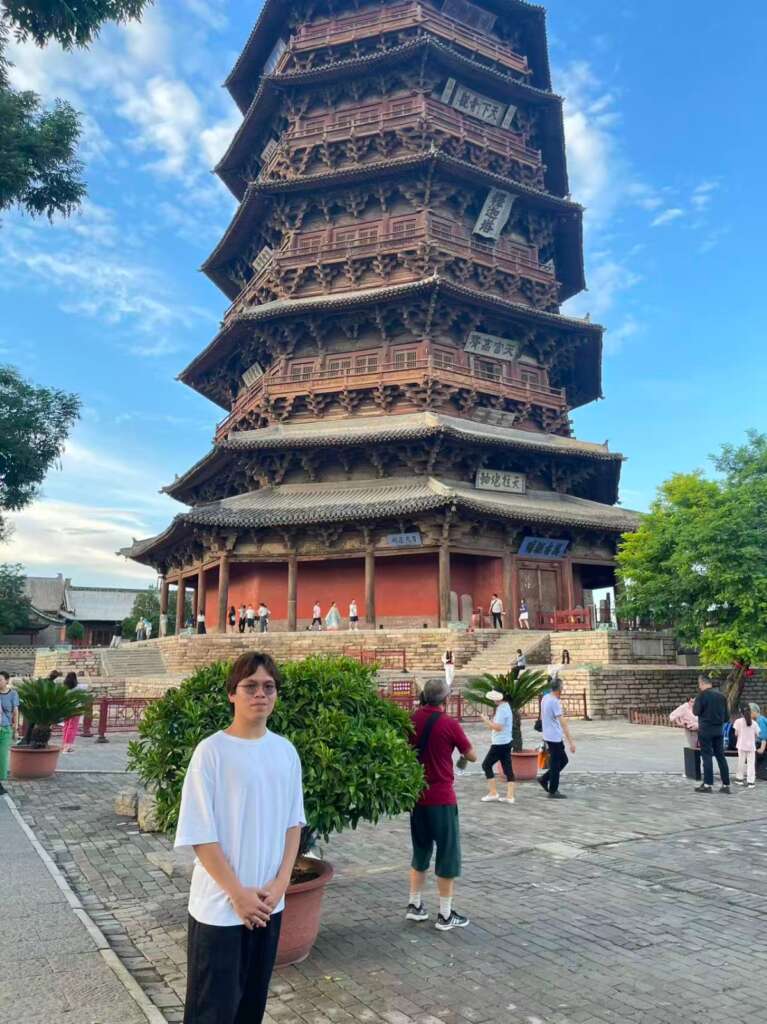
We were astonished by the meticulous Buddha statues in the Yungang Grottoes, the solid mortise-and-tenon structure of the Yingxian Wooden Pagoda, and the rust-free painted sculptures in the Jinci Ancestral Temple—numerous masterpieces of craftsmanship that have stood the test of time for a millennium, and left us in awe.

Standing before the majestic Yanmen Pass, I felt the biting wind and imagined the clashing swords and galloping cavalries of ancient soldiers defending their homeland.
At Stork Tower, I gazed at the towering Huashan Mountain and the tranquil Yellow River. I pictured the scene of poets composing verses, as if I were part of the legendary tales staging on Shanxi’s picturesque landscapes.
AN ANCIENT CITY OF FINANCE
But the most unforgettable ancient landmark was the Pingyao Ancient City, a treasure of both tangible and intangible heritage. Its huge wall encircles grid-patterned streets and alleys.
Here stands not only a well-preserved Ming and Qing dynasty county government office, but also the historical hub of finance in China and the base of Shanxi merchants.
The Piaohao draft banks and armed escort agencies tell tales of their glorious past. The Shanxi merchants, who “connected to the world with bank drafts,” were not only astute in business but they also embraced notions of unity, patriotism and martial valor, and acted for justice and generosity.
These enduring virtues of merchants are vividly portrayed in the scenes of the live performance Seeing Pingyao.
Hong Kong, being one of the world’s top financial centers today, has far surpassed the achievements of the Shanxi merchants. Yet, while material heritage is easily preserved, the collective consciousness is hard to maintain. With the change of time, what commendable spirits and values would we leave behind? And how shall we pass these stories down to future generations and share with the world? These questions are worth pondering.
NOW DOWN TO WORK
These visits took place on weekends. But as part of the trip, I had commenced my internship at Shanxi Huaju Law Firm. Since the legal systems of Hong Kong and the mainland China differ significantly, as the first-ever intern with a Common Law background at the firm, I was worried about adapting to a new environment.

However, my mentor reassured me that the fundamental principles of law are universal, which greatly encouraged me. Every day, I studied the differences between the two legal systems while consulting other lawyers on practical knowledge.
I was dedicated to legal tasks such as drafting civil complaints and defenses, preparing legal analysis, and recommending litigation strategies. I also observed three court and arbitration proceedings and fostered a deeper understanding of the mainland’s legal procedures.
While discussing issues with my colleagues who did not have legal backgrounds, I listened carefully to their interpretations and reduced their arguments into legal analyses, appreciating the diversity of interdisciplinary collaboration.
I also applied the legal knowledge I gained in Hong Kong to offer alternative perspectives on cases and experimented the collision of legal systems with other lawyers. Through these tasks, I was enlightened about the importance of maintaining an open and flexible mindset, learning humbly, and integrating knowledge. That was the way to stay competitive in an increasingly interconnected cross-regional market, while being mindful of cultural differences to avoid misunderstandings.
SOFT SKILLS – AND AFTERNOON NAPS
I witnessed lawyers negotiating with clients and the countering parties and having conflicts with official personnel. Even I was left bewildered by the officers’ questioning on multiple occasions.
These experiences made me realize that it is not merely solid knowledge and a sharp mind which make up a competent lawyer, but also soft skills—handling interactions with tact and firmness while recognizing one’s own shortcomings.
Finally, I found that Shanxi’s people strike a balance between work and life as they work diligently yet maintain a relaxed pace of life. Their refreshing habit of having an afternoon nap, in particular, is worth following.
HONG KONG PEOPLE CAN LEARN FROM VISITS
Hong Kong and Shanxi, though distant from each other, had traits that became a harmonious symphony to me.
I was dumbfounded by the ingenuity of ancient craftsmen and the legendary tales of merchants, and I strengthened my understanding of the mainland’s legal practices, accumulated precious practical experience, and I enhanced my professional skills.
As a Chinese idiom says, “Reading ten thousand books is not as good as traveling ten thousand miles.” The relics seen with my own eyes, the stories heard with my own ears, and the ethical values demonstrated by the locals cannot be fully captured by words.
I hope that young people from both regions forge ahead with our development, exchange our cultures actively, deepen mutual understanding, apply what we learn to their internships, and make substantial progress in the future together.
This report was kindly written for the “friday” project in Hong Kong by Tang Chun-man. The Shanxi Internship Program 2025 was organized by Hong Kong Shanxi Union Community Ltd.
Image at the top shows the South Gate in Datong, Shanxi. The photographer was Chlukoe/ Creative Commons.