
Almost a third of Hong Kong’s land will be blended into an extraordinary plan for a new super-city.
It’s huge: the size of the UK’s Birmingham, or Kansas City in the US.
Prof Herman Hu says that Hong Kong’s Northern Metropolis can take inspiration from Xiong’an, the “city of the future” being built south of Beijing, which he recently visited.
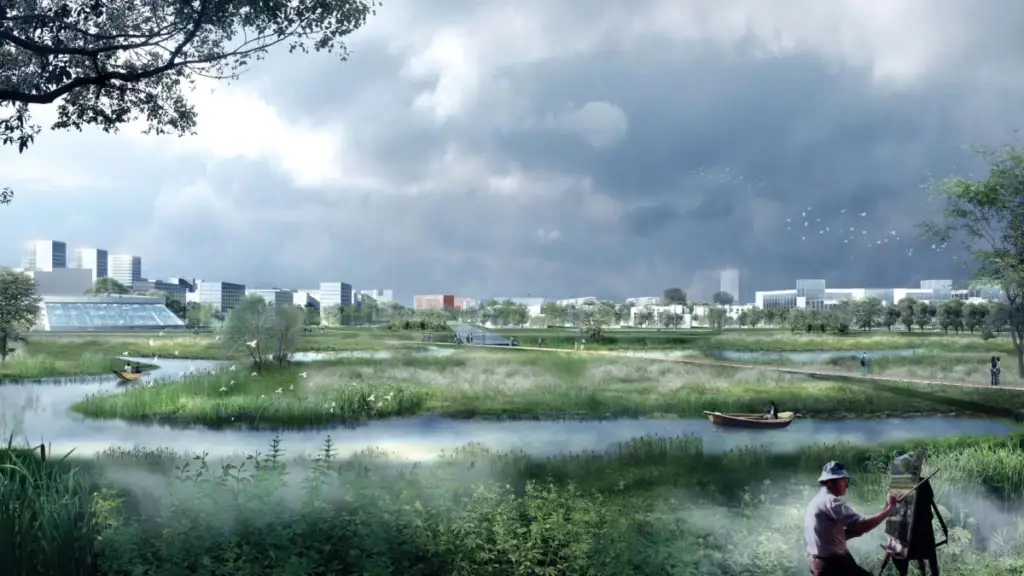
IN A LARGE AREA OF towns, woodlands, and fishponds, Hong Kong planners want to build a city of the future (image at the top).
I’ve just seen what a city of the future looks like—in a recent visit to a remarkable district 1,800 km to the north of Hong Kong.
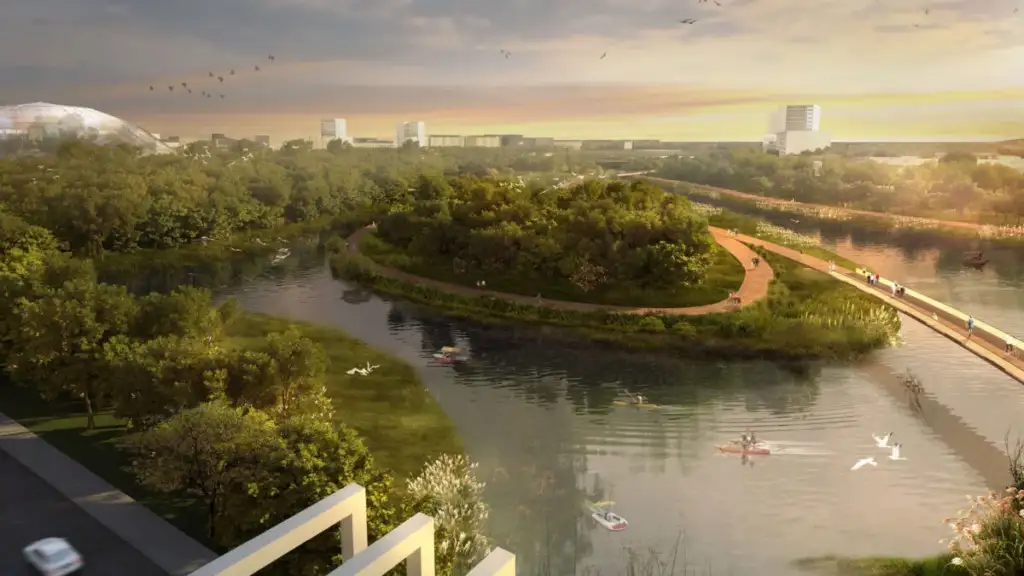
The Chinese central government is developing a futuristic new city called Xiong’an New Area, three times the size of New York City, in Hebei, south of Beijing (below).
One of the many extraordinary things about Xiong’an is that it is being created in three dimensions: a city above the ground, a city below the ground, and a parallel digital city.
It’s a huge venture, and building it will span more than a decade. As the Xiong’an project progresses (it started in 2017), much has been learned. We can take strategic insights from the project for Hong Kong.
.
TRANSFORMATION OF HONG KONG
First, consider the size and location of Hong Kong’s new urban center. Many people think of the Northern Metropolis as a planned “new town” on the New Territories’ side of the border with Guangdong.
But that’s not really what it is at all.
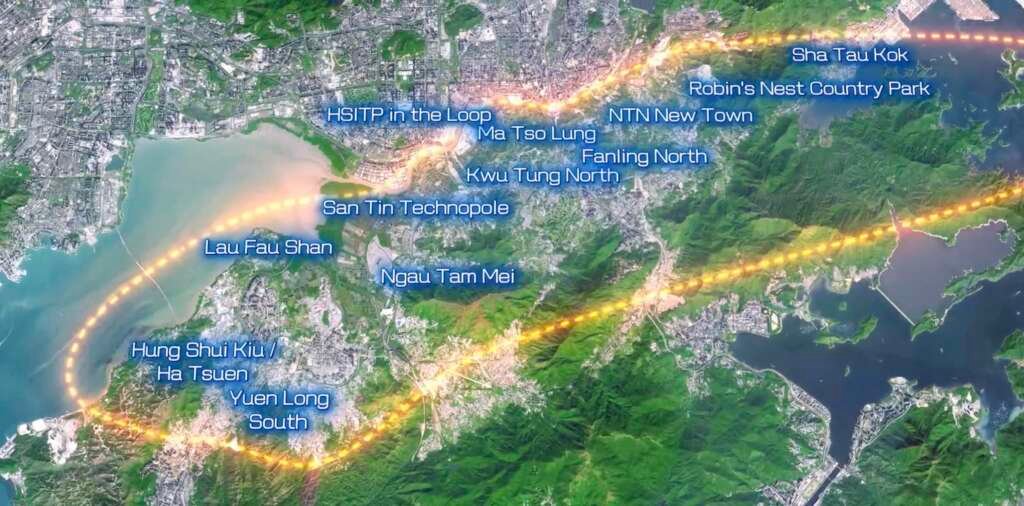
It’s a total redesign of almost one third of Hong Kong’s entire land area: covering 30,000 hectares out of 111,457 hectares.
As such, it will take in Yuen Long, Lau Fau Shan, North Fan Ling, Shau Tai Kok and other existing areas. It will eventually hold 2.5 million people—which is about one third of Hong Kong’s present population.
.
A CITY ACTING AS A BRIDGE
But of course, it’s not just the huge scale of the project which is interesting, but the location, bridging Hong Kong and the Chinese mainland.

The building of the Northern Metropolis is a core priority in the 15th Five-Year Plans of both the Central Government and Guangdong Province, which officially designate it as a “national-level strategic metropolitan area”. Positioned as China’s gateway to the world and a premier hub for international innovation and technology, the region will serve as a new engine for Hong Kong’s economic future.
To reach its full potential, the Northern Metropolis must look beyond mere industrial growth and prioritize robust, integrated infrastructure—spanning housing, transport, education, healthcare, and community amenities.
The region can only attract premier global corporations and top-tier talent by cultivating an environment where people can thrive both personally and professionally.
.
PHYSICAL AND DIGITAL INFRASTRUCTURE
In this regard, Hong Kong can draw valuable insights from Hebei Province’s Xiong’an New Area, which serves as a benchmark for the parallel development of physical and digital infrastructure for a “city of the future.”
During a recent visit to the Xiong’an New Area, alongside the Hong Kong delegation to the National People’s Congress, I was deeply impressed by its highly efficient, forward-thinking urban planning.
I witnessed first-hand the immense strategic resolve and execution power driving the vision to “stick to one blueprint to the very end”.
As a milestone national initiative and a millennium project personally mapped out by General Secretary Xi Jinping, Xiong’an bears the critical mission of relieving Beijing of non-capital functions and driving the coordinated development of the Beijing-Tianjin-Hebei region.
.
HUGE COLLABORATIVE PROJECT
The top-level design and master plan represent the most collaborative urban planning endeavor in Chinese history. It has pooled the collective wisdom of over 60 academics from the Chinese Academy of Sciences and the Chinese Academy of Engineering, alongside more than 3,500 leading experts in urban planning, geography, water conservancy, and architecture.
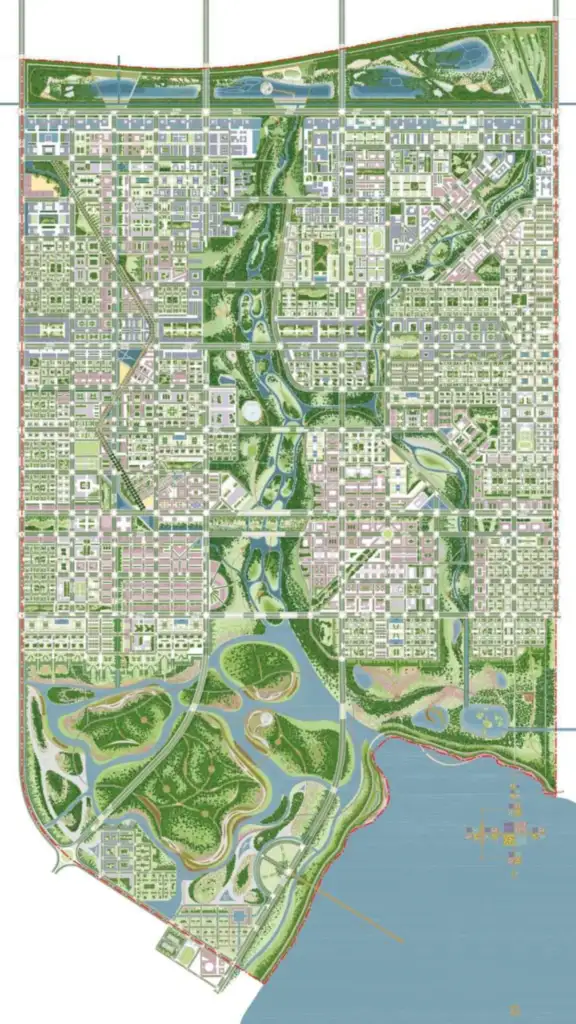
Furthermore, 12 world-class design teams were selected to compete for the core start-up area’s blueprint. It is truly a masterpiece forged by uniting global expertise and national strength.
Xiong’an New Area seamlessly merges traditional Chinese urban planning concepts, such as a grid layouts and axial symmetry, with cutting-edge smart city, digital twin, and ecological “sponge city” frameworks.
.
THREE PARALLEL DIMENSIONS
As the world’s first city designed and built simultaneously “above ground, underground, and in the cloud”, it serves as a blueprint for next-generation urban development.
– Above ground, the city features low-density, human-scale streetscapes woven with abundant green spaces.
– Underground, a meticulously engineered, multi-level infrastructure network houses subterranean transit corridors and vast utility tunnels that centrally manage water, power, energy, communications, and automated waste disposal.
– In the cloud, a digital twin of the city is managed by the Xiong’an Urban Computing Center, which serves as a centralized “city brain” for real-time monitoring and AI-driven governance. Every asset, from blueprint to building, is digitally mapped and strictly regulated.
This entire ecosystem is backed by a dedicated management committee and service bureaus that have streamlined administrative approvals to ensure seamless, highly coordinated development.
.
UNLIKE HONG KONG’S FRAGMENTED MODEL
Hong Kong’s historical “small government, big market” approach has resulted in fragmented, protracted, and often inefficient land development procedures. Faced with fierce global competition, accelerating Hong Kong’s transition into a world-class smart city is an urgent economic imperative.
To achieve this, the HKSAR Government should dispatch officials to conduct comprehensive, on-site research in the Xiong’an New Area. Establishing a structured exchange and cooperation mechanism will allow Hong Kong to absorb and adapt Xiong’an’s pioneering urban planning models and advanced spatial utilization strategies.
Hong Kong should expedite a smart city blueprint tailored to its own context, adopt innovative concepts in urban design and community management, and enact streamlined regulations to speed up development. By referencing Xiong’an’s innovative model of university-city integration, Hong Kong can develop into a premier city of the future under the “One Country, Two Systems” framework.
This will support high-tech industries such as artificial intelligence and biomedicine, making the city livable, business-friendly, and highly appealing to tourists, while truly integrating into and serving broader national development strategies.
Innovation is the primary driver of development; without fresh thinking and forward-looking ideas, no progress can be truly sustainable. The development of Xiong’an New Area exemplifies this by prioritizing a people-centered and eco-friendly approach, setting a high benchmark for both quality and practicality.
Its meticulous, resident-focused services, in particular, provide valuable lessons. Ultimately, if Hong Kong is to inject a continuous source of momentum into its sustainable development, it must foster innovation and embrace change across all sectors.
Professor Herman Hu is a Hong Kong Deputy to the National People’s Congress, Past President of the Hong Kong Professional and Senior Executives Association, and heads the Friday news project, of which fridayeveryday is the website.
Read other articles by Herman Hu by clicking here.